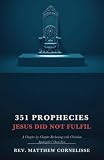
351 Prophecies Jesus Did Not Fulfil
Rev. Matthew Cornelisse
Rev. Matthew Cornelisse’s 351 Prophecies Jesus Did Not Fulfil is an essential resource for scholars, pastors, and students of biblical hermeneutics. By applying the scriptural benchmark of Deuteronomy 18:22, Cornelisse systematically dismantles the popular apologetic claim that Jesus fulfilled 351 Old Testament prophecies. Through a rigorous, verse-by-verse analysis of original contexts and translations, he demonstrates that these claims often rely on superficial lists rather than textual evidence. This meticulous study is highly recommended for those seeking a critical evaluation of messianic claims.
Full review
In 351 Prophecies Jesus Did Not Fulfil, Rev. Matthew Cornelisse offers a rigorous challenge to a cornerstone of Christian apologetics: the claim that the statistical improbability of Jesus fulfilling 351 Old Testament prophecies proves his messianic identity. Cornelisse argues that this high-volume approach relies on superficiality, where a few compelling examples mask widespread inaccuracies. His central thesis is that none of these 351 cited prophecies remain valid after a detailed, verse-by-verse examination. This work is an essential resource for serious Bible students and scholars who wish to move beyond cursory lists and engage in a systematic, slow analysis of biblical claims.
Cornelisse’s methodology is grounded in the internal biblical benchmark of Deuteronomy 18:22, asserting that a genuine prophecy must describe a concrete, observable event in the physical world. By applying this consistent standard, he demonstrates that many cited "prophecies" are actually different literary forms—such as hymns, legal codes, or narratives—or were fulfilled by historical figures like Solomon and Zerubbabel long before the Christian era. He further highlights the failure of explicit messianic expectations, such as the eradication of global warfare and the repatriation of the Jewish diaspora.
What sets this scholarship apart is its commitment to transparency and independent verification. Utilizing the World English Bible as a primary source, Cornelisse provides precise citations and open reasoning, allowing readers to verify his claims against their own preferred translations. The text is organized by logical failure rather than biblical sequence, moving from obvious objections to technical arguments. Scholars are encouraged to approach this work as a comprehensive reference guide, prioritizing the quality of the evidence over the author's credentials to determine if the biblical texts truly support the claims of apologetics.