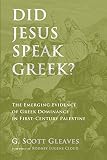
Did Jesus Speak Greek?: The Emerging Evidence of Greek Dominance in First-Century Palestine
G. Scott Gleaves
G. Scott Gleaves challenges the "Aramaic Hypothesis" by arguing that Koine Greek was far more dominant in first-century Palestine than traditional scholarship suggests. Integrating archaeological evidence from ossuaries and papyri with a linguistic analysis of the New Testament, Gleaves posits that the Greek scriptures are original compositions rather than translations. This work is essential for scholars and students of the historical Jesus seeking a rigorous, evidence-based reevaluation of the linguistic landscape of the New Testament.
Full review
In Did Jesus Speak Greek?: The Emerging Evidence of Greek Dominance in First-Century Palestine, G. Scott Gleaves offers a provocative challenge to the traditional "Aramaic Hypothesis," which posits that Aramaic was the overwhelmingly dominant language of the New Testament era. Gleaves argues that Koine Greek was far more prevalent across Judea, Samaria, and Galilee than previously assumed, suggesting that Greek may have even served as the primary language for both Jewish and non-Jewish populations in the Galilee region. Utilizing a rigorous methodology that integrates the 28th edition of the Novum Testamentum Graece and the Biblia Hebraica Stuttgartensia, Gleaves supports his thesis through a multidisciplinary analysis of archaeological findings—including pottery, papyri, ossuaries, and stone inscriptions—alongside the linguistic characteristics of the New Testament.
This work is essential reading for biblical scholars and serious students of the historical Jesus, as it questions whether the Greek New Testament consists of original writings rather than translations from Aramaic sources. Gleaves highlights the multilingual nature of Roman Palestine, noting that while Latin was restricted to military and political spheres and Hebrew to sacred study, Greek functioned as the international common tongue. He points to the trilingual sign on the cross in the Gospel of John and the adoption of Greek names by Jewish figures as evidence of widespread bilingualism. By proposing that the Semitic phrasing in the New Testament reflects a spoken hybrid language rather than a translation process, Gleaves provides a sound, unique logic that carries far-reaching implications for the formation of the Gospels. Scholars should approach this text as an exceptional academic achievement that demands a reconsideration of the linguistic environment of the first century.