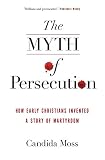
The Myth of Persecution: How Early Christians Invented a Story of Martyrdom – Revealing Pious Exaggerations and Forged Theology in Antiquity
Candida R. Moss
Candida R. Moss challenges the traditional narrative of the "Age of the Martyrs," arguing that the image of a perpetually persecuted early church was often a pious construction used to forge a distinct theological identity. Through a critical historical lens, Moss examines how exaggerated accounts and forged narratives shaped Christian self-perception. This work is essential for scholars, students, and clergy seeking to decouple historical reality from ideological myth. Highly recommended for those interested in early church history and the sociology of religion.
Full review
In The Myth of Persecution: How Early Christians Invented a Story of Martyrdom, Candida R. Moss provides a provocative examination of how the narrative of systemic victimization has been constructed and utilized within the Christian tradition. Moss’s central thesis challenges the traditional "Age of the Martyrs" framework, arguing that the perceived history of constant, state-sponsored persecution is often a product of pious exaggeration and forged theology rather than historical reality. By analyzing the trajectory from the biblical portrayal of Jesus as an unjust victim to the graphic, popular accounts of apostolic deaths—such as the skinning of Bartholomew—Moss demonstrates how the early church established a behavioral template that romanticized suffering as a virtuous path to divine union.
This work is essential for serious students of ecclesiastical history and sociology, as it meticulously traces the evolution of martyrdom from the era of Nero and the stoning of Stephen to the Reformation-era narratives of John Foxe. Moss distinguishes her scholarship by linking these ancient constructs to contemporary phenomena, illustrating how the "persecution complex" persists today. She examines how modern digital tributes to victims of terrorism, such as Mariam Fekry, and the political rhetoric of figures like Bishop Daniel R. Jenky, continue to frame social conflicts as cosmic struggles between the church and evil forces.
Scholars should approach this text as a critical interrogation of religious identity. Moss warns that while the language of martyrdom can provide meaning during trauma, it can also be co-opted to legitimize retributive violence or brand political disagreements as spiritual warfare. This is a vital recommendation for anyone seeking to understand how historical memory is shaped to serve present-day ideological agendas.